Frequently Asked Questions

What is Solar PV?
PV is short for Photovoltaic, these are Solar Panels that absorb the energy from the sun and convert it into electrical energy, this energy is then converted into usable power by a Charge Controller for DC Off Grid systems such as Caravan, Motorhome etc. or an Inverter for AC applications such as home appliances. The power produced by the Solar Panels is DC (Direct Current).
What is the difference between Polycrstalline and Monocrystalline Solar Panels?
Monocrstalline Solar Panels are generally more powefull than Polycrystalline panels. Polycrytsalline panels are generally blue in colour and look as if there are many parts to the cell, this is because they are made from multiple silicon cells melted together. Monocrstalline cells are of a darker and more uniform colour.
Monocrystalline panels generally have a longer lifespan than their Polycrystalline counterparts.
What is a Charge Controller?
A Charge Controller is an electrical device that converts the DC power, often at very high voltages into usable power to charge the batteries. Typical systems are 12V, 24V or 48V DC. Equipment that is specifically designed to run on DC will be required and for the systems voltage.
There are two types of Charge Controller:
- PWM (Pulse Width Modulation. These controllers are generally cheaper, they are less efficient than their MPPT (Maximum Power Point Tracking) counterparts. They are ideal for small scale Solar systems where power generation efficency isn't critical.
- MPPT (Maximum Power Point Tracking). These controllers are more efficient than the PWM controllers, they adjust the output dependant on the power curve from the PV array giving the highest charge rate possible. There are generally some options to monitor and configure MPPT controllers, the Victron SmartSolar Controllers have built in Bluetooth for monitoring and configuration from an App.
What is an Inverter?
An Inverter converts the DC (Direct Current) power from a Battery Bank into AC (Alternating Current) for home appliances which run on mains voltage typically 230-240V in the UK.
There are two types of inverter:
- Off Grid Inverters convert the DC power into AC power for small applicance used in locations where there is no grid connection.
- Grid Tied Inverters convert the DC power into AC which is then connected directly to your own grid supplied AC in your house etc. any power that is unused or stored in special batteries will be sent back to the grid.
Going Off-Grid? Here’s a Quick Formula to Calculate Your Solar & Wind Power Needs!
1. Find Your Daily Energy Usage (Wh)
- List all devices & their wattage
- Multiply each by hours used per day
Example:
- Fridge (40W × 12h Assuming 50% Compressor time) = 480Wh
- Lights (10W × 5h) = 50W
- Phone charging (5W × 2h) = 10Wh
- Total = 540Wh/day (0.540kWh)
2. Calculate Required Solar Panels (W)
Formula: Solar Panel Size = Daily Wh ÷ Sun Hours Per Day
Example (UK winter, 4 sun hours):
- 540Wh ÷ 4h = 135W
- Recommendation: At least 200W solar to account for inefficiencies.
3. Battery Storage Needed (Ah)
Formula: Battery (Ah) = Daily Wh ÷ Battery Voltage
- 12V system: 540Wh ÷ 12V = 45Ah
- 24V system: 540Wh ÷ 24V = 22.5Ah-
- 48V system: 540Wh ÷ 48V = 11.25Ah
- For 2 days backup, double the Ah value!
⚠️ Using Lead Acid? Remember to double the battery capacity to avoid discharging below the recommended 50% depth of discharge (DoD).
4. Adding Wind Power (Optional)
- Wind turbines work at night & on cloudy days
- A 400W wind turbine can generate ~2kWh/day in good wind conditions—a great backup!
Tip: Always oversize your system slightly to account for inefficiencies & bad weather.
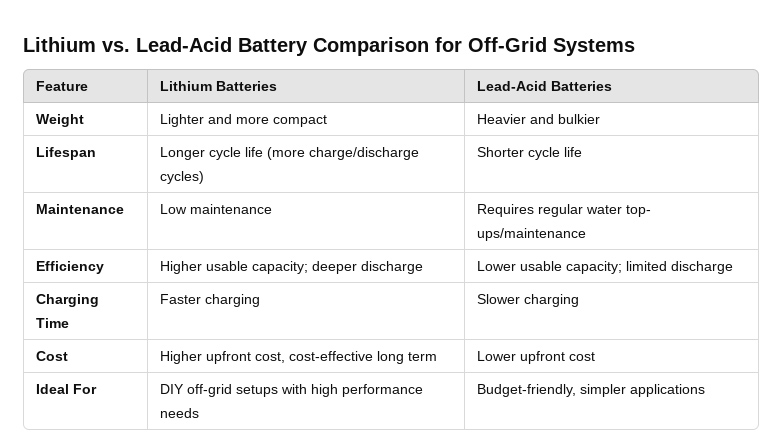
What are the main differences between Lithium and Lead Acid Batteries?
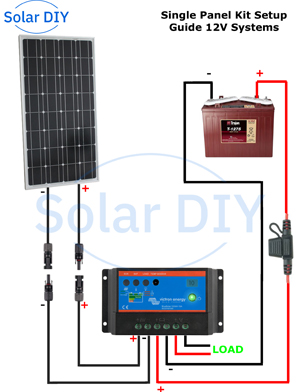
Solar System Connections - Single Panel - Series - Parallel
- Single Solar Panel systems are very simple to install and require minimal cabling. A pair of Solar PV Cables connect from the Solar Panel Positive to the Charge Controller Positive likewise with the Negative. The same applies for the connections from the Charge Controller to the Battery, Positive to Positive and Negative to Negative. The Cable from the Charge Controller to the Battery must be fused.
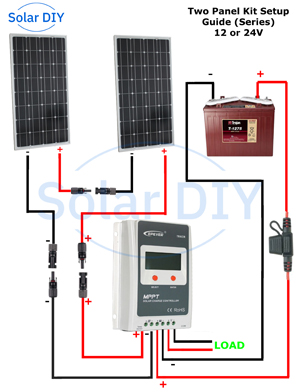
What is the difference between Series & Parallel connections in Batteries and Solar Panels?
- Series circuits are where the Positive connection of one Solar Panel or Battery connects to the Negative of the next, this creates in effect a round circuit. See example below of two Solar Panels connected in Series. The benefits of this are lower current rated components required which are generally cheaper. With Series systems the voltage will increase with each device added however the current will stay the same. These circuits are generally used for Solar arrays with an MPPT Controller, or if for example if two 12V Batteries are connected in Series to create a 24V Battery bank with the same Ah (Amp Hours). The Cable from the Charge Controller to the Battery must be fused.
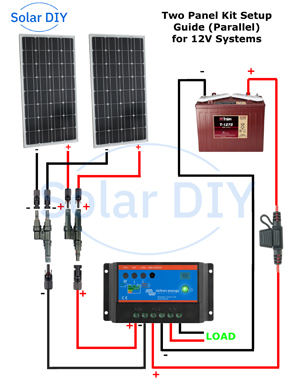
- Parallel circuits are where the Positive of one Solar Panel or Battery is connected the the Positive of the other likewise with the Negative. This configuration increases the current rating of the system but keeps the voltage the same. Parallel connections are generally used for two or more solar panels to connect to a PWM controller which is 12V or 24V. The cabling and other system parts will generally be more expensive than Series due to the higher current rating. For example two 12V batteries connected in Parallel will stay at 12V but the Ah (Amp Hours) rating will double. The Cable from the Charge Controller to the Battery must be fused.